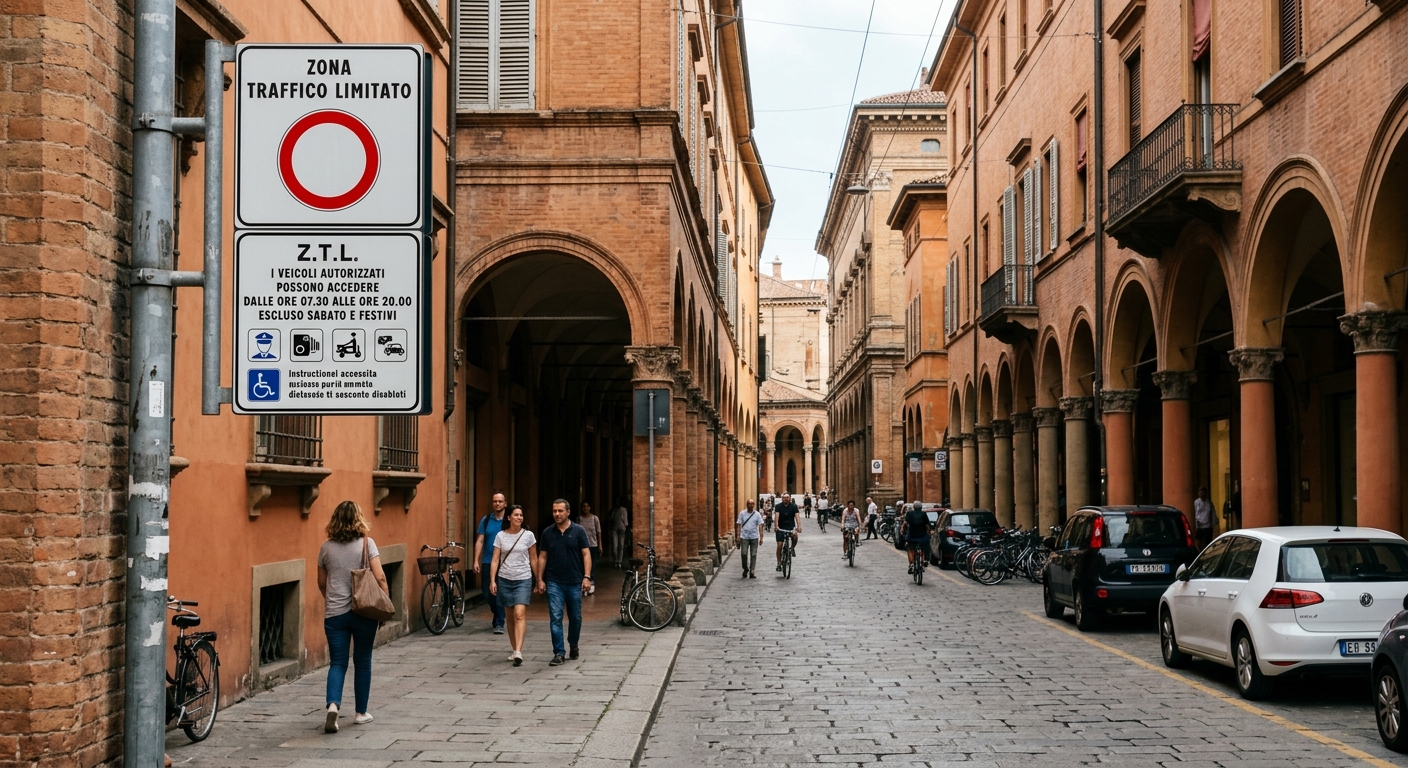
ZTL Bologna 2026: complete guide to limited traffic zones, Città 30 and parking
Bologna does not have just one ZTL (limited traffic zone). It has at least four different overlapping regimes, an environmental plan that ties permits to the Euro class and fuel type of the vehicle and, since 2023, a complicated history of speed limits, in which a court annulled everything in 2026 and the municipality started again from a more targeted plan. For anyone arriving with a rental car who does not know the city, the real risk is not so much getting stuck: it is driving through a gate without knowing it and finding a fine notice at home weeks later.
This guide explains how the ZTL of the historic centre is organised, what changes between ZTL A, Zona T and the special zones, how tickets and permits work (including the new rules for electric and hybrid cars from 2026), what Città 30 provides today after the ruling of the TAR (the regional administrative court) and where to leave the car near the centre without spending anything, or almost nothing.
In brief
The ZTL of the historic centre (Sirio system) is active every day from 7:00 to 20:00. Outside these hours access is free. Anyone without a permit can buy a daily ticket for 6 euros or a four-day ticket for 15 euros, but it must be activated before entering: there is no way to regularise an entry after the gate. Zona T (via Rizzoli, via Indipendenza, via Ugo Bassi) has stricter rules and becomes fully pedestrian at weekends. Electric cars enter free almost everywhere; hybrids, from 2026, have lost free access if the driver does not live in the municipality. To park without paying, the main reference points are the park-and-ride car parks such as Certosa and Parco Nord (always free) and the blue bays, which are free on Sundays and public holidays throughout the city.
In this article
- How the Bologna ZTL is organised
- Hours and Sirio and Rita gates
- The Garisenda Tower construction site
- Tickets for occasional access
- Environmental ZTL: how it works
- Electric and hybrid cars: the rules from 2026
- The standard resident permit
- Loading and unloading, craftsmen and urgent work
- Bologna Città 30, after the TAR ruling
- The parking plan: blue, white and yellow bays
- Where to park to reach the centre for free (or almost)
- Penalties and how to challenge the fine notice
- ZTL Bologna and rental cars
- Frequently asked questions
How the Bologna ZTL is organised
The historic centre is protected by ZTL A, the camera system known as Sirio. It covers the area inside the ring roads.
Within this perimeter there are stricter regimes, monitored by the Rita remote-control system: the Zona T (via Rizzoli, via Indipendenza, via Ugo Bassi), the Zona Università (the Belle Arti and Belmeloro sectors, around via Zamboni) and some special ZTLs on individual streets, such as San Francesco-Pratello, Moline-Capo di Lucca, the Archiginnasio area and the bus-only lanes. They are not the same thing and they do not have the same hours. A vehicle authorised for ZTL A is not automatically authorised for Zona T, for the Zona Università or for the other special zones.
| Zone | Hours | Who can enter |
|---|---|---|
| ZTL A (Sirio) | 7:00-20:00, every day | Permit, digital ticket or pass |
| Zona T | Weekdays: reserved for authorised vehicles. Weekends and public holidays: pedestrian (T-Days) | Only holders of a specific pass |
| Zona Università | 24/7 | Cycle and pedestrian area, closed to cars, motorcycles and mopeds |
| Special ZTLs (San Francesco-Pratello, Moline-Capo di Lucca, Archiginnasio, bus lanes) | 24/7 | Permitted vehicles only |
Anyone arriving for the first time who reads only “ZTL 7-20” on the satnav sees just half of the story. Zona T, Zona Università and the special ZTLs follow their own rules, almost always stricter.
Hours and Sirio and Rita gates
The basic rule is simple: ZTL A is active every day from 7:00 to 20:00. Outside these hours anyone can enter, even without a permit. Pedestrian areas and Zona T during the hours when it is pedestrianised remain closed to traffic in any case.
Sixteen Sirio cameras guard the main entrances to the centre. Among the best-known gates: Porta Santo Stefano, Porta San Vitale, via Alessandrini, via Marconi, via Riva di Reno, via San Felice, via Sant’Isaia, via Saragozza, viale XII Giugno, via D’Azeglio, via Borgo di San Pietro, via Finelli, via Mascarella, via Capo di Lucca, via Chiudare, via Bocca di Lupo and via degli Angeli.
Zona T, Zona Università and the special ZTLs have gates of their own instead, monitored by the Rita system and active 24 hours a day. On weekdays Zona T stays open only to holders of a specific pass. On Saturdays, Sundays and public holidays it becomes a fully pedestrian area, the so-called T-Days, closed to any motor vehicle.
The Garisenda Tower construction site
For a few years now piazza di Porta Ravegnana and the stretch of via San Vitale between via Zamboni and via Rizzoli have been closed for the monitoring and structural restoration of the Garisenda Tower, a project that will last several more years.
To balance the tram and tower construction sites, a municipal order has temporarily suspended the Rita remote control in Zona T for the stretch heading from via Ugo Bassi to via Rizzoli, making it easier for residents, holders of private parking spaces and goods delivery vehicles to reach the first stretches of via Castiglione and via Strada Maggiore. Access to the area of Strada Maggiore and the neighbouring streets (vicolo Alemagna, piazza del Francia, via De’ Pepoli) follows different time bands depending on the environmental class of the vehicle. Anyone who needs to drive through there with a rental car would do well to check the signs on site: the hours change from one category to another and may be updated with new orders linked to the progress of the works.
In the area, via San Vitale is closed just after the junction with via Guido Reni, with a compulsory right turn into via Benedetto XIV for those who are not authorised. Via Castel Tialto has reversed its direction of travel and has become a pedestrian street with reduced speed for permitted vehicles only.
Tickets for occasional access
Anyone without a pass can still enter ZTL A by buying a digital ticket, valid for vehicles up to 80 quintals.
- Daily ticket: 6 euros, valid until 24:00 on the day of validation
- Four-day ticket: 15 euros, valid for four consecutive days
Warning
The ticket must be bought and activated before entering the gate, not after. Unlike other Italian cities, in Bologna it is not possible to regularise an entry that has already taken place: anyone who passes without an active ticket receives a fine notice straight away.
The system also limits the number of tickets that can be bought per number plate: a maximum of 3 daily tickets or 1 four-day ticket per month, to prevent them from becoming a way to get around the permanent environmental requirements. Tickets only authorise access to the general ZTL: they do not override the bans in the protected areas that are active 24 hours a day (Zona T, Zona Università, special ZTLs) and they do not include parking, which remains at the standard rate.
There is also an annual “36 accessi” ticket, designed for residents or holders of a parking space who have lost their pass for environmental reasons. It costs 216 euros and allows 36 entries into ZTL A and into the special ZTLs of San Francesco and Università over a period of 365 days. It does not cover Zona T and does not entitle the holder to free parking.
Environmental ZTL: how it works
Since 1 January 2020 Bologna also applies environmental criteria, not only residence or work activity: the fuel type and the Euro class of the vehicle determine whether a pass can be issued or renewed.
Two categories remain outside these limitations, regardless of the vehicle owned: holders of a pass for people with disabilities (CUDE) and resident households, holders of an R pass, with an ISEE below 14,000 euros, upon submission of the certificate to the competent offices.
For those who voluntarily give up their only pass (R or Pa), the municipality has set up the Bonus Mobilità Sostenibile: a contribution of 700 euros, which drops to 500 euros if the surrender concerns a single pass within a household that holds more than one.
Electric and hybrid cars: the rules from 2026
The rules change considerably depending on the type of engine, and the difference has become sharper from 2026.
100% electric cars
By registering the number plate and obtaining the dematerialised pass through the operator BomoB, a fully electric vehicle can travel freely in the ZTL of the historic centre, in Zona T and in the special areas active 24 hours a day, including Zona Università and San Francesco-Pratello, with the sole exception of urban pedestrian areas. Parking on the blue bays is free and without time limits, including the fast-turnover areas, and the vehicle can also drive through during emergency blocks for air pollution.
Hybrids: end of free access for non-residents
Hybrid vehicles, identified by code P.3 on the vehicle registration document, have grown so much in number in recent years that they triggered a review clause provided for by the municipal traffic plan. The result, from 1 January 2026, changes things considerably for anyone driving a rental car:
- Non-residents of the municipality of Bologna (individuals or businesses without a registered office in the municipality): no more free access to the ZTL. An occasional entry requires the purchase of the ordinary tickets, with payment for parking on blue bays as for any combustion-engine vehicle.
- Residents of Bologna: they keep access to the ZTL with the virtual permit, but free parking on the blue bays remains valid only for permits starting before 31 December 2025, and only until their natural expiry.
- Residents of Emilia-Romagna but not of Bologna: they can still access the ZTL only with a permit issued by 31 December 2025, with a discount on parking subscriptions until the title expires.
There is also a detail on duration: permits for hybrid vehicles issued from 1 May 2025 last one year, no longer two as before.
Good to know if you rent a car
From 2026 a hybrid car no longer guarantees free access to the ZTL if the driver does not live in the municipality of Bologna, which is the case for almost everyone who rents a car in the city. Only a fully electric vehicle keeps full free access, without exceptions.
The standard resident permit
Different from the occasional ticket, the resident permit is a virtual pass (the most common codes are “R” for residents and “Pa” for those with a parking space in the ZTL), registered in a database. There is nothing to display on the windscreen: the check is made on the number plate.
How to apply
The application is submitted online with SPID on the municipality’s services portal, or on a paper form at the mobility desk, attaching an identity card, a certificate of residence, the vehicle registration booklet and, where required, the ISEE. The outcome arrives by email and the permit is active only after confirmation. Entering the ZTL before receiving it means risking the same penalty as someone with no authorisation at all.
Duration and cost
The duration is generally multi-year, up to 5 years for an ordinary pass (only one year for hybrid permits issued from 2025, as seen above), but it remains subject to the environmental ZTL rules: if the vehicle becomes incompatible, the pass is revoked and replaced, when possible, by the annual “36 accessi” ticket. The permit is not free: the fee varies according to ISEE, fiscal horsepower and environmental category of the vehicle, with the reductions seen in the previous section for low incomes and low-emission vehicles. The exact figures are in the municipality’s updated fee schedule and must be checked case by case, because they are subject to periodic revisions.
Loading and unloading, craftsmen and urgent work
For those who work in the centre, the logic changes again. There are operational passes, both annual and temporary, for own-account distribution, third-party distribution, craftsmen and installers: categories A, Ds, Dsi and F. These too are virtual, checked by the Sirio and Rita systems and by the handheld devices of traffic wardens.
Here too the environmental ZTL applies, in an even stricter form than for ordinary permits: the municipality no longer issues new operational passes or temporary passes for diesel vehicles up to and including Euro 4, petrol Euro 0 and Euro 1, LPG or methane Euro 0 and Euro 1.
For work involving vehicles up to 80 quintals, the fee schedule for temporary permits is structured as follows (to which a virtual revenue stamp of 16 euros on the application is always added):
| Duration | Access area | Fee ≤80 q.li | Fee >80 q.li |
|---|---|---|---|
| 5-30 days | ZTL A or ZTL A + U | 56 euros | 84 euros |
| 5-30 days | ZTL A + T or ZTL A + T + U | 111 euros | 167 euros |
| 31-90 days | ZTL A | 84 euros | 125 euros |
| 31-90 days | ZTL A + T or ZTL A + U + T | 167 euros | 251 euros |
| 91-180 days | ZTL A | 125 euros | not applicable |
Exempt from administrative fees, although subject to registration or stamp duty where provided, are temporary permits for a parking space inside ZTL A for electric, hybrid, methane or LPG vehicles, and those for school transport, doctors on duty and assistance to people who are not self-sufficient.
Bologna Città 30, after the TAR ruling
Here the story is more complicated than it looks from the outside.
On 1 July 2023 Bologna launched the “Città 30” project, bringing the speed limit to 30 km/h on about 70% of the road network inside the ring road, with fines starting from 16 January 2024. It lasted until January 2026: the TAR of Emilia-Romagna annulled the founding resolution, upholding the appeal of the taxi drivers’ associations. The court ruled that a municipality cannot impose a reduced limit across the board on the whole urban territory: every exception to the general 50 km/h limit must be justified street by street, with objective conditions of danger for vulnerable users or specific characteristics of the road fabric.
The municipality responded without giving up its objective. On 18 March 2026 the Giunta (the municipal executive) approved the new Piano Particolareggiato on speed management, built by a technical and legal team of 20 specialists that produced a justification sheet for every single road section concerned. The new orders came into force on Monday 20 April 2026, restoring the 30 km/h limit on 258 km of secondary and neighbourhood roads.
Città 30 timeline
1 July 2023: the 30 km/h limit starts on about 70% of roads.
16 January 2024: fines begin.
January 2026: the TAR of Emilia-Romagna annuls the plan.
18 March 2026: the Giunta approves the new Piano Particolareggiato.
20 April 2026: the new orders come into force, 30 km/h on 258 km of roads.
The areas involved are mainly the Barca, Borgo Panigale, Corticella, Santa Viola, Saragozza and Toscana districts. The recurring reasons: high residential and commercial density, missing pavements or very narrow streets, proximity to schools, hospitals, museums, universities and places of worship.
The general 50 km/h limit remains instead on the major through roads: the ring roads (except the stretch in front of the Stazione Centrale), via Stalingrado and the Togliatti-Gandhi-Tolmino-Sabotino and Lenin-Po-Torino-Benedetto Marcello axes.
For anyone driving in Bologna today, the practical consequence is that the centre and the residential districts involved must be driven at 30 km/h, while on the main routes the limit remains the ordinary one. It is worth watching the vertical signs street by street: the new plan is more precise than the old one, but also less uniform.
The parking plan: blue, white and yellow bays
Parking on public land follows a plan divided into six sectors of the historic centre (from 1 to 5, plus zone U) and twelve outer zones, from A to Q. The rules change according to the colour of the road markings:
- Blue bays: paid parking on weekdays. It becomes completely free on Sundays and public holidays, in all zones of the city, including the historic centre.
- White bays: reserved free of charge, 24 hours a day, for residents of the sector or zone. Non-residents can park there for a maximum of two hours, with the “two hours” title bought at the pay-and-display machines or at TPER sales points and displaying the arrival time with the parking disc.
- Fast-turnover areas: they have blue bays but no indication of sector or zone. There are no benefits for residents and no subscriptions: everyone pays, from 9:00 on weekdays.
- Yellow bays: free parking reserved for vehicles with a disability pass (CUDE), emergency vehicles, law enforcement and other authorised categories.
Rates fall as you move away from the historic core:
| Zone | Hourly rate | Daily flat rate | Monthly subscription |
|---|---|---|---|
| Cerchia del Mille | 3.90 euros (minimum 0.60 euros) | not available | 100 euros |
| Centro Storico | 2.90 euros (minimum 0.50 euros) | not available | 100 euros |
| Semi-central ring (A1, B, C, D, E, F) | 2.20 euros (minimum 0.40 euros) | 11 euros | 50 euros (200 euros for six months) |
| Semi-peripheral ring and outskirts (A2, I, L, M, N, P, Q) | 1.80 euros (minimum 0.30 euros) | 9 euros (6 euros in some zones) | 40 euros (150 euros for six months) |
Fast-turnover areas follow the same hourly amounts as the zone in which they are located, but with no possibility of a weekday subscription.
Where to park to reach the centre for free (or almost)
The most effective way to avoid paid parking and ZTL risk is through the park-and-ride car parks run by TPER, designed precisely to leave the car outside the centre and continue by public transport.
The main park-and-ride car parks
| Car park | Spaces | Rate | How it becomes free |
|---|---|---|---|
| Certosa (viale Gandhi) | 325 | Always free, 24 hours a day | No conditions required |
| Tanari (via Luigi Tanari 17) | 280 | 0.60 euros/hour, 30 euros/month | Free 24h with P+BUS (1.30 euros) or P+BICI |
| Prati di Caprara | 160 | 2.20 euros/hour on weekdays, 9:00-18:00 | Free all day on weekdays with P+BUS |
| Antistadio (via Andrea Costa) | 283 | Weekday blue-bay rate | Free 24h with P+BUS or P+BICI (annual card) |
| Santa Viola / Ferriera | 52 | Semi-peripheral ring rate | Free all day on weekdays with P+BUS |
| Parco Nord (via Stalingrado 83) | 750 | Free, except for events at the Arena | No conditions, outside events |
The P+BUS formula cancels the cost of parking for 24 consecutive hours: all you need is a public transport subscription loaded on the MiMuovo card, or to buy a 1.30 euro urban ticket at the car park’s automatic machine before boarding the bus. At Tanari validation is done by showing the paper ticket or the contactless transaction of the Roger app to the booth operator; when the booth is unattended, as happens in the evening and on public holidays, the barrier rises automatically and exit remains free even without validation.
The P+BICI formula, available at Tanari, works in the same way for those who leave the car and continue with their own bicycle, provided it is registered and marked with the Securmark anti-theft system.
Always free, no conditions
Certosa (viale Gandhi, 325 spaces) and Parco Nord (via Stalingrado, 750 spaces) are free 24 hours a day, with no bus tickets, subscriptions or validations. They are the two simplest options for anyone arriving with a rental car who does not want to think about anything else.
Free on-street parking, outside the official schemes
There are also outlying areas not subject to weekday charges, from which the centre is still within reach by bus:
- Piazzale Atleti Azzurri (Bologna Est): free and unrestricted car park, connected to the centre by lines 11, 16 and 27
- Via Zanardi (Lame area, Bologna Nord): white bays with unrestricted parking near the stops with direct service to via Marconi and the station
- Zona Murri: free on-street parking, with a bus to piazza di Porta Santo Stefano and the centre in under five minutes
- Via Saliceto (Bolognina, near the Museo per la Memoria di Ustica): free on Sundays, line 27 towards the centre
- Parcheggio Marco Polo (via Mario Fantin, 99 spaces): paid on weekdays, but completely free on Sundays and public holidays, a short walk from Porta Lame
How much the bus to the centre then costs
Anyone who leaves the car in a park-and-ride car park and continues by TPER bus pays, apart from the P+BUS integration, these fares: single ticket at 2.30 euros (sales points or contactless on board, valid 75 minutes), on-board ticket paid in coins at 2.50 euros, CityPass book of 10 rides at 19 euros, day ticket at 9 euros. Anyone paying with a contactless card on board enters the “Best Fare” system, which automatically applies the most convenient fare, with a daily cap equal to the day ticket and a weekly cap of 25 euros.
Penalties and how to challenge the fine notice
Unauthorised access to ZTL A, Zona T or ZTLS falls under the violations of article 7 of the Codice della Strada (Highway Code). Detection is automatic, through the Sirio/Rita cameras, and the fine notice arrives by post to the registered keeper of the vehicle, within 90 days of the offence.
| Situation | Amount |
|---|---|
| Base amount + notification costs | 84 euros + about 13 euros (total about 97 euros) |
| Payment within 5 days (30% discount) | About 58.8 euros on the base amount, plus costs |
| Payment after 60 days | Amount doubled, plus interest and collection costs |
| Maximum ceiling with aggravating circumstances | About 335 euros |
Each passage under an active gate with an unauthorised number plate is, as a general rule, a separate violation: entering and leaving several times on the same day can mean several fine notices, even though some case-law positions try to treat repeated entries as a single course of conduct.
How to challenge the fine notice
First rule: paying the reduced amount is, in effect, accepting the penalty. Anyone who wants to appeal should not pay with the 30% discount before assessing the situation.
There are two routes:
- Appeal to the Prefect, within 60 days of notification: free of charge, but if it is rejected the amount doubles. It is worth filing when there are clear formal defects (inadequate signage, a distance of less than 80 metres between sign and gate, incomplete fine notice, notification arriving after the 90 days, unreadable photo).
- Appeal to the Justice of the Peace, within 30 days of notification or of the Prefect’s decision: it requires a unified court fee of about 43 euros, but it allows you to bring witnesses and argue the case on its merits (a medical emergency, a valid permit not communicated in time, a number plate not sent by the hotel). If the appeal is rejected, the penalty remains the original one, with no doubling.
It is advisable to gather evidence before choosing: photos of the signage, a copy of the founding order, any documentation on permits or emergencies. The Prefect costs nothing but risks doubling the amount; the Justice of the Peace has an initial cost but more room for assessment.
ZTL Bologna and rental cars
Anyone who picks up a rental car in Bologna and needs to travel towards the historic centre can stay outside ZTL A and use one of the park-and-ride car parks (Certosa and Parco Nord are always free), continuing on foot or by bus. Or buy the daily or four-day ticket, activating it before crossing a gate, not after.
There is one point worth clarifying, because it has changed compared with a few years ago: from 2026 a hybrid rental car no longer has free access to the ZTL if the driver is not a resident of the municipality of Bologna, and most people who rent a car in the city are not. Only a fully electric vehicle keeps free access in the ZTL, Zona T and special areas, with free parking on the blue bays without time limits. For those who travel often in the centre during their stay, an electric car rental is the choice that really makes a difference today.
The rest of ZTL A has a schedule that is easy to remember: 7:00-20:00, then free passage. The harshest restrictions remain concentrated on a handful of streets, Zona T, not on the whole historic centre.
For those arriving from the airport, the team at the Autovia branch at Bologna airport can suggest the best route to the accommodation without crossing active gates. Those arriving by train can turn to the Autovia branch at Bologna station in the same way, already located outside the heart of Zona T. For other questions about rentals, the FAQ page and the Autovia customer service remain the direct channels.
Frequently asked questions about the Bologna ZTL
Is the Bologna ZTL active at night or at weekends?
ZTL A (Sirio) of the historic centre is active every day from 7:00 to 20:00, weekends included: outside these hours access is free for everyone. Zona T follows a different logic, however: on weekdays it stays reserved for authorised vehicles only, while on Saturdays, Sundays and public holidays it becomes completely pedestrian (the so-called T-Days). The Zona Università is also closed 24 hours a day to cars, motorcycles and mopeds.
If I enter the ZTL without a ticket, can I regularise the access afterwards?
No. In Bologna the daily ticket (6 euros) or four-day ticket (15 euros) must be bought and activated before entering the gate. There is no procedure to remedy an entry that has already taken place by buying the ticket at a later time. Anyone who enters without authorisation receives the fine notice directly.
Can a hybrid rental car still enter the ZTL in Bologna for free?
Not from 1 January 2026, if the driver does not live in the municipality of Bologna. Hybrid cars have lost free access to the ZTL for non-residents: you need to buy the ordinary tickets and pay for parking as for a combustion-engine vehicle. Residents of Bologna keep access, but free parking on the blue bays is valid only for permits issued before 31 December 2025. Only a fully electric car keeps full free access to the ZTL and on the blue bays, without exceptions linked to residence.
Where can I park for free near the centre of Bologna?
The Certosa (viale Gandhi) and Parco Nord (via Stalingrado) park-and-ride car parks are always free, with no conditions. Tanari, Prati di Caprara, Antistadio and Santa Viola/Ferriera become free for the whole day with the P+BUS formula (1.30 euro urban ticket) or P+BICI. Alternatively, the blue bays are free on Sundays and public holidays throughout the city, including the historic centre.
Does Bologna still have the 30 km/h limit everywhere?
No, no longer across the board. The original 2023 plan was annulled by the TAR of Emilia-Romagna in January 2026, because it imposed the limit on the whole territory without street-by-street justification. The municipality approved a new Piano Particolareggiato, in force since 20 April 2026, which restores 30 km/h on 258 km of secondary and neighbourhood roads, above all in the Barca, Borgo Panigale, Corticella, Santa Viola, Saragozza and Toscana districts. On the ring roads and the main through roads the 50 km/h limit remains.
How much is the fine for unauthorised access to the ZTL in Bologna and how do you challenge it?
The base amount is 84 euros, plus about 13 euros of notification costs: the total comes to about 97 euros. By paying within 5 days you get the 30% discount provided for by the Codice della Strada. To challenge the fine notice there are two routes: an appeal to the Prefect within 60 days (free, but if rejected the amount doubles) or an appeal to the Justice of the Peace within 30 days (fee of about 43 euros, but more chance to argue the case on its merits).


