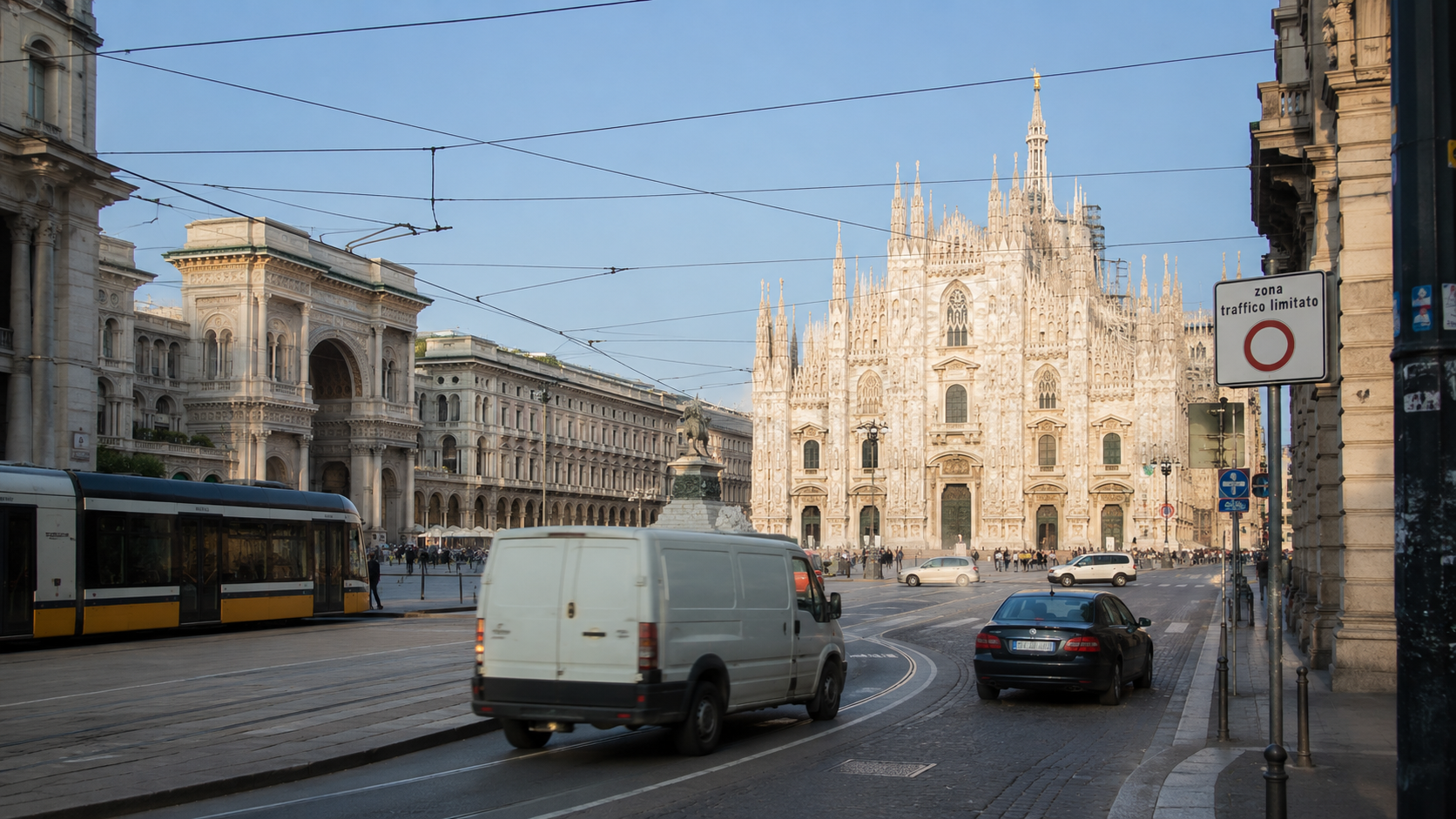
ZTL Milan: complete guide to Area B, Area C and neighbourhood zones
Milan’s traffic restriction system is among the most complex in Italy. It is not just the Area C of the historic centre: there are two overlapping macro-areas, more than ten limited traffic zones in individual neighbourhoods, pedestrian areas with their own rules and a calendar of bans that tightens every year on 1 October.
Understanding how each zone works, which vehicles can enter and when, how much you pay and what happens if you get it wrong is useful before any journey. This guide covers everything, from the boundaries of Area B to the ZTL (limited traffic zone) areas of the metropolitan hinterland.
In brief
Area B covers almost the whole municipality and is free: whether you can enter depends on the environmental class. Area C covers only the centre within the Cerchia dei Bastioni and costs 7.50 euros per day. Both are active Monday to Friday, from 7:30 to 19:30, public holidays excluded: they do not operate on Saturday and Sunday. In both, diesel vehicles from Euro 0 to Euro 5 and petrol vehicles from Euro 0 to Euro 3 are banned. Euro 6 diesels can still circulate: the ban arrives in 2028 for Euro 6 A, B and C, then in 2029 in Area C and in 2030 in Area B for Euro 6 D-TEMP and D. From 1 October 2026, Euro 5 diesels are banned across the whole urban area of Milan under a regional rule, not only inside Area B. Electric cars enter everywhere without paying, and hybrids enter Area C for free if they stay under 100 g/km of CO2. Anyone with a banned vehicle can use MoVe-In or the exemption days, which must be activated before entering.
In this article
- Milan’s concentric model
- Area B: the metropolitan Low Emission Zone
- Area C: the congestion charge in the historic centre
- ZTL Quadrilatero della Moda
- Neighbourhood ZTL zones
- The main pedestrian areas
- School zones and Piazze Aperte
- ZTL in the hinterland: Melzo
- Access for tradespeople and emergency work
- Penalties: the full picture
- Car rental in Milan and ZTL zones
- Frequently asked questions
Milan’s concentric model: how the zones overlap
Milan has built its traffic policy on a structure of concentric circles. At the centre is Area C, which coincides with the Cerchia dei Bastioni. Around it, and often overlapping it, is Area B, which covers almost the whole municipal territory. Outside these two main levels, the neighbourhood ZTL zones, the pedestrian areas and the school zones operate.
Access control is fully automated: a network of 188 cameras with optical number plate reading (OCR) guards the boundaries of Area B; further electronic gates manage Area C and the individual ZTL zones. There are no physical toll booths. The passage is recorded and any penalty arrives by post, addressed to the vehicle’s registered owner, even weeks later.
For anyone arriving in Milan with a rental car, the starting point is always the same: check the vehicle’s emission category before setting off, because the restrictions apply whether or not you are aware of the zone you are crossing.
Area B: the metropolitan Low Emission Zone
Area B coincides with almost the whole Municipality of Milan. It works as a Low Emission Zone with free access: no toll is paid, but passage is banned for vehicles that do not meet certain emission requirements.
Operating days and hours
Area B is active Monday to Friday, from 7:30 to 19:30. On Saturdays, Sundays and weekday public holidays it is not operating: on those days there are no restrictions linked to the Low Emission Zone. The regional bans of the Po basin still apply, however, and follow their own rules.
Excluded vehicles: category M1 (private cars)
The bans on cars have tightened progressively. This is the situation updated to July 2026:
| Category and fuel | Status of the ban | Operating notes |
|---|---|---|
| Petrol Euro 0, 1, 2 | Permanently excluded | Access only with MoVe-In or bonus days |
| Petrol Euro 3 | Excluded from 1 October 2025 | First year with support measures (MoVe-In or bonus days) |
| Diesel Euro 0, 1, 2, 3 without FAP | Permanently excluded | Absolute ban during the hours in force |
| Diesel Euro 3 with factory-fitted FAP | Permanently excluded if the particulate value (field V.5 of the registration document) is not specified or exceeds the threshold | If the value is missing from field V.5, the manufacturer’s type-approval certificate is required |
| Diesel Euro 4 without suitable FAP | Permanently excluded | Includes vehicles with an aftermarket FAP installed after 31/12/2018 that does not guarantee Euro 4 class |
| Diesel Euro 5 | Permanently excluded | From 1 October 2026 the ban extends to the whole urban area under the regional rule, therefore also outside the boundaries of Area B |
| Diesel Euro 6 A, B, C | Allowed until 30 September 2028 | The type-approval subclass is shown in field V.9 of the registration document |
| Diesel Euro 6 D-TEMP and Euro 6 D | Allowed until 30 September 2030 | Two years more than Euro 6 A, B and C |
| Dual fuel diesel-LPG or diesel-methane Euro 0-4 | Permanently excluded | Exclusion linked to the diesel component of combustion |
| Petrol Euro 4, 5, 6 | Allowed | Petrol Euro 4 will be excluded from 1 October 2028 |
Fully electric cars do not appear on any ban list. Hybrids, on the other hand, follow the restrictions of the fuel they burn: a petrol hybrid Euro 6 enters without problems, while a diesel hybrid Euro 5 is banned like any other Euro 5 diesel. LPG and methane are also free, provided the other fuel is petrol. Dual-fuel diesel-LPG and diesel-methane vehicles up to Euro 4 remain excluded.
If you are renting a car
If the vehicle you pick up is a Euro 6 diesel, you can drive in Area B without limitations and enter Area C by paying the ordinary ticket. This is the case for most recent rental fleets. The problem concerns diesels from Euro 5 downwards, and petrol vehicles up to Euro 3. The class is written in field V.9 of the registration document: it takes thirty seconds to check and avoids a fine of around a hundred euros.
From 1 October 2026 Euro 5 diesels are banned outside Area B too
From 1 October 2026 Lombardy Region bans diesel Euro 5 cars from circulating in municipalities with more than 100,000 inhabitants, Milan included, from Monday to Friday between 7:30 and 19:30.
The difference lies in the perimeter. Inside Area B these vehicles have been banned for some time; the regional rule extends the ban to the whole urban area, therefore also to the roads outside the blue gates where until now a diesel Euro 5 could circulate. The legal reference is Law 105/2025 with resolution 4843 of the Regional Executive of 28 July 2025. For diesel Euro 5 commercial vehicles the same measure applies one year later, from 1 October 2027.
Warning
Anyone who owns a diesel Euro 5 and has so far simply avoided the blue gates no longer has that loophole from October 2026: the regional restriction has no gates and applies on all urban roads during the same hours. The practical alternative is MoVe-In, which allows driving within an annual mileage cap.
Motorcycles, mopeds and commercial vehicles
Two-wheelers and vans also follow a progressive calendar of exclusions:
- 2-stroke motorcycles and mopeds Euro 0-1 and diesel Euro 0-1: already permanently excluded
- 2-stroke motorcycles and mopeds Euro 2-3, diesel Euro 2-3 and 4-stroke petrol Euro 0-2: excluded from 1 October 2027, after the one-year extension decided by the Executive
- 4-stroke petrol motorcycles and mopeds Euro 3: excluded from 1 October 2028
- Goods commercial vehicles over 12 metres: permanent ban, except for special authorisations for abnormal loads or construction sites
Anyone riding a scooter in Milan therefore still has a full year ahead before the tightening reaches the oldest two-wheelers as well.
The blind spot requirement
From 2026 vans (N2), buses (M2, M3) and heavy vehicles (N3, larger M3) must be equipped with acoustic, visual or tactile warning systems to detect obstacles in the front and right-hand side blind spot. The measure protects cyclists and pedestrians. During 2025 a transitional window was provided for those who had already ordered the devices; from 2026 installation and type approval are effective requirements.
How to get around anyway: MoVe-In and bonus days
Anyone who owns an excluded vehicle has two tools to keep using it occasionally.
MoVe-In (Monitoraggio Veicoli Inquinanti) requires the installation of a satellite black box that counts the kilometres travelled in Area B, 24 hours a day and 7 days a week, including the times when the zone is not active. The cost is 50 euros the first year (30 euros for installation + 20 euros for the service) and 20 euros for annual renewals. Each vehicle is assigned an allowance: a petrol Euro 3, for example, has 1,500 km per year. Once those kilometres are used up, the vehicle can no longer circulate in Area B until the following 1 January.
Bonus days work on a time basis. When a ban comes into force, owners get 50 days of free access in the first year without prior registration. From the second year, registration on the municipal portal is compulsory. Residents of Milan have 25 days per year; non-residents only 5, to be activated in advance on the platform before each entry.
Warning
The exemption must be activated before entering, not after. An entry into Area B already recorded by the cameras cannot be regularised afterwards, unlike the Area C ticket, which has seven days. Anyone who joins MoVe-In, moreover, gives up the other exemptions: the two routes cannot be combined.
Historic vehicles
Vehicles with a Certificate of Historical Interest (CRS) between 20 and 40 years old have 25 days of access per year, subject to registration on the municipal platform. Vehicles over 40 years old with a CRS are completely exempt from the bans, provided the number plate is accredited.
Park-and-ride car parks for those not entering the city
Over time the municipality has expanded the park-and-ride car parks connected to the metro, designed for those who want to leave the car outside Area B and continue by public transport. The main ones:
| Car park | Weekday / holiday hours | Metro / transport |
|---|---|---|
| Bisceglie | 5:30-01:00 / 6:00-01:00 | M1 |
| Cascina Gobba | 5:30-01:00 / 6:00-01:00 | M2 |
| Cologno Nord | Open 24h | M2 |
| Comasina | Open 24h | M3 |
| Famagosta | 5:30-01:00 / 6:00-01:00 | M2 |
| Gessate | Open 24h | M2 |
| Molino Dorino | 5:30-01:00 / 6:00-01:00 | M1 |
| Quarto Oggiaro | Open 24h | Trenord (suburban lines) |
| San Donato / Paullese | 5:30-01:00 / 6:00-01:00 | M3 |
| Cassiodoro (Tre Torri) | Hours to be checked | M5 |
Area C: the congestion charge in the heart of Milan
Area C delimits the historic core within the Cerchia dei Bastioni. Anyone entering pays a toll, regardless of the vehicle’s emission category (with certain exemptions). The aim is to reduce congestion in the densest part of the city, not only to limit emissions.
Operating days and hours
Area C is active all year, Monday to Friday, from 7:30 to 19:30, public holidays excluded. On Saturdays and Sundays the gates are not in operation, so anyone arriving in Milan at the weekend for shopping or tourism enters the historic centre without a ticket.
Area C at weekends
For months there have been reports of an extension of Area C to Saturday and Sunday. At the moment this is not the case: the municipality’s pages indicate the hours as Monday to Friday, public holidays excluded. It remains a rule that a resolution can change, so for a planned trip it is worth checking again on the municipality’s website.
Fees in detail
| Profile | Cost | Conditions |
|---|---|---|
| Standard fee | 7.50 euros/day | Unlimited entries and exits with the same vehicle on the same day |
| Residents in Area C | 3 euros/day | First 50 entries per year free, subject to registration on MyAreaC |
| Registered service vehicles | 4.50 euros/day | Reserved for company vehicles registered with the CCIAA for technical services |
| Parking in affiliated garages | 4.50 euros/day | Only if the stay in the garage exceeds one hour. Ticket bought in the garage, to be activated by midnight of the same day |
| Deferred ticket (regularisation) | 22.50 euros | Can be bought on MyAreaC within 7 days of the unpaid entry |
| NCC (chauffeur-driven hire) over 9 seats up to 8 m | 60 euros | Tour coaches and large NCC vehicles |
| NCC over 9 seats from 8 to 10.5 m | 97.50 euros | Includes 5 hours of free parking in the dedicated car parks |
| NCC over 9 seats over 10.5 m | 150 euros | Long-distance tour coaches |
| NCC school bus (school trips) | 7.50 euros | Nursery and lower secondary schools |
The ticket is not a free pass
Area C is a paid zone, but on top of the toll there remains an environmental ban. If the vehicle falls into a banned class it does not enter, and paying the ticket changes nothing: the penalty arrives all the same. First you check the class, then you buy the ticket.
How to buy the ticket
The available channels are: the Area C online portal, parking meters across the municipal territory, authorised Intesa Sanpaolo cash machines, SISAL terminals and PUNTOLIS tobacconists, newsstands and bars affiliated with LIS Pay, Telepass (only for vehicles registered in Italy), UnipolMove and PayPal. Direct debit (RID) remains active for those who set it up by 14 September 2012. Anyone parking in an affiliated garage buys the reduced ticket directly in the garage. Finally, there is the telephone number 02 4868 4001, active every day from 7:00 to 24:00.
The ticket must be activated by midnight of the day of entry. Anyone who does not activate it in time can use the deferred ticket of 22.50 euros within 7 days on the MyAreaC portal. Beyond that deadline the ordinary penalty applies.
Who enters for free
Some categories do not pay the ticket:
- Fully electric vehicles: free access
- Hybrids with CO2 emissions equal to or below 100 g/km: the figure is found in field V.7 of the registration document. Hybrids above that limit are treated like combustion vehicles and pay 7.50 euros
- Vehicles for disabled people: those who display the badge with the holder on board, or those with a vehicle permanently adapted for reduced mobility. Registration in the municipal system or enrolment in the national CUDE platform is required
- Rescue and public service vehicles: ambulances, civil protection, police forces, fire brigade and vehicles used in emergency operations
Not all exemptions work in the same way: some are automatic, others require the number plate to be accredited. Before the first entry it is worth opening the MyAreaC portal and checking which of the two cases applies to your vehicle.
The timetable of bans until 2030
Area C has already set the next deadlines. Anyone planning stays in Milan in the coming years can use this table as a reference:
| Date | Excluded categories |
|---|---|
| Already in force | Petrol Euro 0, 1, 2 and 3; all diesels from Euro 0 to Euro 5; dual fuel diesel-LPG or diesel-methane Euro 0-4; 2-stroke motorcycles Euro 0-1 and diesel Euro 0-1 |
| 1 October 2027 | Petrol Euro 4; 2-stroke motorcycles Euro 2-3, diesel Euro 2-3 and 4-stroke petrol Euro 0-2 |
| 1 October 2028 | Diesel Euro 6 A, B and C; 4-stroke petrol motorcycles Euro 3 |
| 1 October 2029 | Diesel Euro 6 D-TEMP and Euro 6 D |
| 1 October 2030 | Petrol Euro 5; 2-stroke motorcycles Euro 4 and diesel Euro 4-5 |
For Euro 6 diesels the date that counts depends on the type-approval subclass, shown in field V.9 of the registration document: Euro 6 A, B and C leave the scene a year before Euro 6 D-TEMP and D. From 1 October 2029, when the latter will also be excluded, only petrol vehicles from Euro 6, hybrids and electric vehicles will remain able to enter the historic centre.
Area B follows its own calendar: petrol Euro 4 and diesel Euro 6 A-B-C from 1 October 2028, Euro 6 D-TEMP and D from 1 October 2030. For several classes, therefore, the historic centre closes before the rest of the city.
The ZTL Quadrilatero della Moda
Of all the zones in Milan, this is the most restrictive of all. The Quadrilatero della Moda is active 24 hours a day, 7 days a week, with no exceptions for weekends or public holidays.
Street perimeter
The ZTL comprises the network of streets bounded by: Corso Matteotti, Corso Monforte (section between via Cino Del Duca and Piazza Filippo Meda), Corso Venezia (section between via Senato and Piazza San Babila), Largo Mattioli, Piazza Belgioioso, Piazza della Scala (numbers 4 and 6), Piazza Meda, Piazza San Babila (number 5 only) and the related internal side streets.
Motorcycles and mopeds can still enter freely, but only until 11 May 2028. From 12 May 2028 the ban will extend to them as well.
Permits for residents and temporary occupants
Residents and temporary occupants (including those with a documented temporary residence) must apply for two separate electronic permits:
- Pass Sosta (Ambito di Sosta 1 – 1A): allows parking in the reserved on-street bays. It is requested online through the Fascicolo del Cittadino.
- Pass Accesso e Transito (ZTL Quadrilatero della Moda – Transito): required to drive in the area. It is requested digitally or in person at the offices of the Local Police Zone 1, via Beccaria 19.
To obtain the permits you need the vehicle registration document, an identity document and a driving licence. Temporary occupants must attach a copy of the lease registered with the Agenzia delle Entrate plus the latest bills for active utilities.
Vehicles on long-term rental (over 6 months), leasing or free loan require the employer’s declaration or the contractual documentation of the rental company. Permits for owned vehicles have unlimited duration; those for rental or loan last up to 3 years or until the contract expires.
The guest pass for visitors
Accredited residents and temporary occupants can enable daily access for a guest vehicle. Through the Fascicolo del Cittadino (“Pass Accompagnatore” section) the number plate of the vehicle is entered before entry. Changes are allowed without restrictions before the validity starts; once validity has started, only one change is possible, which automatically cancels the previous authorisation.
Car parks and private garages inside the ZTL
Anyone who owns or rents a garage or parking space inside the ZTL must apply for accreditation in advance. Individuals do so through an online form attaching proof of entitlement to the parking space. Companies have three options: associate a fixed number plate with each parking space, use rotating passes with a dynamic PIN through the SostaLibera platform, or accredit their own company OCR system by sending the municipality a CSV file every day with the number plates, dates and times of entry.
Who enters without a specific permit
Some categories are already on the municipality’s whitelist (Ordinance 441/2015) and do not need to apply for authorisations:
- Taxis and NCC up to 9 seats in active service
- Rescue vehicles, ambulances, fire brigade, Civil Protection, police forces
- A2A vehicles for street cleaning and snow clearing
- Private security vans and cash-in-transit vehicles
- ASST and welfare association vehicles on social and healthcare duty
- Doctors and vets on urgent home visits
- Hearses
Neighbourhood ZTL zones
Every neighbourhood with a strong evening or pedestrian character has its own limited traffic zone. The hours vary significantly from one zone to another.
ZTL Navigli
Active every day from 20:00 to 7:00, with no distinction between weekdays and public holidays. Unauthorised motor vehicles cannot enter; there are no exemptions for hotels in the area. Goods loading and unloading is allowed only between 5:00 and 7:00. The streets included in the Navigli pedestrian area cover the towpaths of the Naviglio Grande and Naviglio Pavese, via Corsico, via Casale, ripa di Porta Ticinese and the connected sections.
ZTL Isola
Active every day from 19:30 to 6:00. Motorcycles circulate freely; residents with specific passes (Filoviaria 9 or Filoviaria 10) are authorised for parking only.
There is one special case: a car can enter the pedestrian area of via Borsieri (section between via Lambertenghi and piazzale Segrino) only if it is carrying a child under 7 or a person with severe mobility difficulties who lives in the pedestrian area itself. The authorisation is daily, issued for a single vehicle per resident before access. For goods vans, loading and unloading operations in via Borsieri are allowed only between 9:00 and 11:00 and between 15:00 and 17:00.
ZTL Arco della Pace
Active every day from 22:00 to 4:00. The ban extends to mopeds and motor vehicles without accreditation. Post-transit regularisation is not allowed: anyone who enters without authorisation has no means of regularising their position afterwards.
ZTL Corso Garibaldi
Permanent, 24 hours a day. It covers the section of Corso Garibaldi between via Pontaccio and largo La Foppa, with three electronic gates at numbers 3, 60 and 117. The area also includes via Anfiteatro, via Tessa, via San Simpliciano and largo La Foppa.
ZTL Paolo Sarpi and ZTL Merci Sarpi
Permanent, 24 hours a day. Access is banned for vehicles longer than the limits set by the municipal regulation (consult the official text for the exact measurement). In the integrated pedestrian area, motor vehicles and mopeds are excluded except with special authorisation linked to residents with a private parking space. Newsstands have an exemption between 6:00 and 7:30.
The ZTL Paolo Sarpi includes within it the ZTL Merci Sarpi, which covers a larger area of neighbouring streets (via Aleardi, via Alfieri, via Bramante, via Fioravanti, via Giannone and many others). Anyone who obtains a permit for the Area Pedonale Sarpi automatically obtains authorisation for the ZTL Merci Sarpi too, but the reverse does not apply.
ZTL Ascanio Sforza
Active Monday to Thursday from 19:00 to 6:00; from Friday evening continuously until Monday morning. It covers via Ascanio Sforza (between via Scoglio di Quarto and via Conchetta) and the side streets indicated in the establishing ordinance. It was set up to contain urban decay and night-time safety problems in the area.
ZTL Ticinese and ZTL Sant’Agostino
These two zones have their own rules linked to emergency-response permits. The ZTL Ticinese covers Corso di Porta Ticinese (between via De Amicis and piazzale 24 Maggio), via Vetere, via Scaldasole, Vicolo Calusca, Piazza Sant’Eustorgio and via Santa Croce. The ZTL Sant’Agostino comprises via Cesare da Sesto and part of piazza Sant’Agostino.
The main pedestrian areas
In addition to the ZTL zones, some areas of the historic centre are classified as pedestrian areas with access banned to all motor vehicles, except expressly authorised categories:
- Area Pedonale Sarpi: via Paolo Sarpi, via Albertini, via Signorelli, via Messina (between via Paolo Sarpi and via Fioravanti), via Arnolfo di Cambio
- Area Pedonale XXV Aprile: Corso Como (entire pedestrian stretch) and sections of piazzale 25 Aprile
- Area Pedonale San Raffaele: via San Raffaele, via Berchet, via Marino, via Foscolo, via Santa Radegonda, piazza San Fedele, via Agnello
- Area Pedonale Brera: via Brera, via Fiori Oscuri, via Fiori Chiari
- Area Pedonale Navigli: the towpaths and sections described in the ZTL Navigli section
School zones and Piazze Aperte
Since 2025 the Municipality of Milan has consolidated a programme of tactical pedestrianisation in front of schools, the so-called “Zone Quietate” or school ZTL zones. They are not limited traffic zones in the traditional sense of the term, but areas removed from traffic near school entrances, with cycle paths and Kiss&Ride areas positioned outside the danger radius.
Two of the interventions consolidated in 2026 are via Maggianico (Municipio 8, connected to the schools of via Cretese and via Brivio, with 1,500 m2 pedestrianised) and via De Nicola (Municipio 6, in front of the De Pretis Nursery School and the De Nicola Primary School, with 800 m2 protected). These areas have no fixed electronic gates, but the ban on passage is signposted and monitored.
ZTL in the hinterland: the Melzo case
Traffic restrictions do not stop at the municipal boundaries of Milan. Melzo, in the Metropolitan City, manages its historic centre with two distinct zones.
The Zona Rossa of Melzo is active 24 hours a day, all year, with no exceptions. It comprises piazza San Francesco, via Matteotti, piazza Vittorio Emanuele II, piazza della Repubblica, via Candiani, via Cattaneo, via Sant’Ambrogio and piazza della Vittoria. Inside this zone no motor vehicles may circulate (including mopeds and motorcycles), with the sole exceptions of bicycles, zero-emission electric vehicles and vehicles with a disabled badge. Goods vans under 3.5 tonnes can enter only between 7:00 and 11:00 and between 15:00 and 17:00 for loading and unloading operations.
The Zona Blu has been suspended by the Municipal Executive to support commercial activities.
Anyone who enters the Zona Rossa without authorisation has 96 hours (4 days) to regularise their position by sending the appropriate substitute declaration form to the municipality’s Ufficio Protocollo (registry office) by PEC or by delivering it directly to the Spazio Città. Beyond that deadline the penalty is around 100 euros (87 euros base plus notification costs).
Access for tradespeople and emergency work
Maintenance tradespeople and installers who fall within the categories provided for by Ministerial Decree 37/2008 can apply for temporary access authorisations in the minor ZTL zones and pedestrian areas for urgent work that cannot be planned. The duration is 24 or 48 hours.
The request must be submitted through the municipality’s portal with SPID Aziendale or ID Azienda authentication, or by PEC or fax with Form 09. The operating rules are precise:
- The request can indicate only one ZTL or pedestrian area; no combining different zones in the same form
- The destination streets and house numbers must be on the official list and not reachable from roads open to public traffic
- The work must be of an objectively unplannable emergency nature; false declarations are criminally prosecutable
- The permit for the Area Pedonale Sarpi automatically includes the ZTL Merci Sarpi, not vice versa
The zones covered by this procedure are: ZTL Garibaldi, ZTL Ticinese, Area Pedonale Sarpi, ZTL Merci Sarpi, ZTL Sant’Agostino, ZTL Barsanti, ZTL Ascanio Sforza, Area Pedonale XXV Aprile, Area Pedonale Navigli, Area Pedonale Brera, Area Pedonale San Raffaele and ZTL Quadrilatero della Moda.
Penalties: the full picture
| Violation | Base penalty | Notes |
|---|---|---|
| Unauthorised passage in Area B | 83 euros + 11-16 euros in costs (total about 94-99 euros) | Repeat offence within two years: licence suspension from 15 to 30 days |
| Non-payment of Area C ticket | From 80 to 335 euros | Can be regularised within 7 days with the deferred ticket of 22.50 euros |
| Unauthorised passage in a neighbourhood ZTL | From 80 to 335 euros | Violation of art. 7 of the Codice della Strada (Highway Code); detected electronically |
| Unauthorised parking inside a ZTL | At least 42 euros | May lead to forced removal of the vehicle |
| Unauthorised entry to the ZTL of Melzo | 87 euros + about 13 euros in costs (total about 100 euros) | Can be regularised by submitting a substitute declaration within 96 hours |
For those renting a car, penalties are initially notified to the rental company, which passes them on to the responsible driver. Autovia offers an assistance service for handling fine notices; for questions about coverage and procedures, the FAQ section of the website and customer service on +39 02 84065 are the direct points of reference.
Car rental in Milan and ZTL zones: a practical guide
For those who pick up a car through car rental at Linate or at Milan Malpensa and then travel into the city, the variable that counts is the class of the vehicle, not just the fuel. A Euro 6 diesel, which is the norm in recent rental fleets, today circulates in Area B without limitations and enters Area C by paying the ordinary ticket. It is diesels from Euro 5 downwards that are banned, and from 1 October 2026 Euro 5 will be banned across the whole urban area under the regional rule.
Anyone arriving by train and picking up the car at Milano Centrale is already inside Area B. The boundary of the Low Emission Zone coincides with the municipal limit: you should not think only of the historic centre, but of all journeys in the city during the working week.
On the practical side: at pick-up it is worth asking the desk for the vehicle’s Euro class and checking it on the registration document, in fields P.3 for the fuel and V.9 for the environmental class. For stays with frequent trips to the centre, an electric car rental removes both the Area B restrictions and the Area C ticket. Before the first entry it is worth checking on the MyAreaC portal whether the number plate needs to be registered for that vehicle.
For parking, the strategy of the park-and-ride car parks along the metro lines makes it possible to leave the vehicle outside the ZTL and continue by public transport. Many of the car parks in the table above are open 24 hours a day and have affiliated rates for those using public transport.
Frequently asked questions about Milan’s ZTL zones
Are Area B and Area C the same thing?
No. Area B is a free Low Emission Zone that covers almost the whole Municipality of Milan: whether you can enter depends on the environmental class, without paying anything. Area C is a paid zone that covers only the historic centre within the Cerchia dei Bastioni. The hours are the same for both, Monday to Friday from 7:30 to 19:30, public holidays excluded. A vehicle entering Area C automatically crosses Area B as well, but the two systems have separate rules and penalties.
Which diesel can still enter Area B in 2026?
Euro 6 diesels circulate normally in Area B. The ban will arrive on 1 October 2028 for Euro 6 A, B and C, and on 1 October 2030 for Euro 6 D-TEMP and D: the subclass is shown in field V.9 of the registration document. All diesels from Euro 0 to Euro 5, on the other hand, are excluded. For these, the MoVe-In system, with a mileage allowance, or the exemption days remain. One deadline to note: from 1 October 2026 Euro 5 diesels are banned outside Area B too, across the whole urban area of Milan, under the rule of Lombardy Region.
How do you pay the Area C ticket with a rental car?
The driver is directly responsible for payment. The ticket is bought by entering the number plate of the rented vehicle through the Area C portal, the parking meters, Intesa Sanpaolo cash machines, SISAL and LIS Pay outlets, Telepass, UnipolMove or PayPal. Activation must be done by midnight of the same day. If you forget, you can buy the deferred ticket of 22.50 euros on the MyAreaC portal within 7 days of entry. Beyond that deadline the ordinary penalty applies, which is notified to the rental company and then passed on to the driver.
Is a hybrid vehicle exempt from all of Milan’s bans?
No, and the distinction matters. Hybrids follow the restrictions of the fuel they burn: a petrol hybrid Euro 6 has no problems in Area B, while a diesel hybrid Euro 5 is banned exactly like any other Euro 5 diesel. In Area C the issue is instead the ticket: a hybrid with CO2 emissions equal to or below 100 g/km, a value in field V.7 of the registration document, enters for free; above that threshold it pays the 7.50 euros like a combustion vehicle. Only fully electric cars are outside every ban and do not pay.
Is the ZTL Quadrilatero della Moda active on Sundays too?
Yes. The Quadrilatero della Moda is active 24 hours a day, 7 days a week, with no exceptions. It is the most restrictive zone in Milan: there is no time window in which passage is free, not even at night or on public holidays. Anyone who is not a resident, a temporary occupant or part of the categories on the municipality’s whitelist cannot enter without a specific permit.


